The right home EV charger comes down to five everyday questions about your car, your driving and your home. Answer them and the charger, solar and battery mostly pick themselves.
Before we start
Three terms come up along the way. kW is speed. kWh is amount. kWh per 100 km is your fuel economy.
kW
How fast energy flows, like how fast the bowser pours.
kWh
How much energy, like litres in the tank.
kWh per 100 km
The EV version of L/100 km. Lower goes further.
1. What do you drive?
Your car decides how far each kWh goes, and how fast it charges at home.
Like petrol cars, EVs vary widely in how much energy they use per kilometre. Below are three reference points along that range, from efficient to thirsty. The further a car goes on each kWh, the less solar and charging time it needs.
Efficient
7.4 km per kWh
13.5 kWh per 100 km
e.g. Tesla Model 3 RWD
Typical
5.7 km per kWh
17.5 kWh per 100 km
e.g. BYD Atto 3, BYD Dolphin
Thirsty
4.2 km per kWh
24 kWh per 100 km
e.g. Volvo EX90, VW ID. Buzz, Kia EV5 AWD
Home charging is slower than a highway charger, and the reason sits inside your car. Its built-in charger converts home AC power to DC for the battery, up to a set limit. Highway fast chargers do that conversion themselves, so they can run at 50 to 350 kW.
7 kW
single-phase only
- BYD Atto 2
- BYD Dolphin
- Most BYD Atto 3s
11 kW
three-phase
- Tesla Model Y
- Tesla Model 3
- BYD Sealion 7
- Kia EV5
- Geely EX5
22 kW
three-phase, rare
- Zeekr 7X
- smart #1 Premium
- Zeekr X AWD
Three-phase cars still charge at about 7 kW on a single-phase supply.
Check your car’s limit before choosing a wall charger. Step 5 covers matching the two.
2. How far do you drive?
A usual day’s driving takes only a few kWh.
Your daily kilometres and your kind of EV set how much energy the car needs each day. Drag the slider to see yours.
At 30 km a day, an efficient EV uses about 4.1 kWh, a typical EV about 5.3 kWh and a thirsty EV about 7.2 kWh.
That daily figure shapes the rest: how much solar to add, and how long the car needs on the charger. The steps below use a typical EV doing 30 km a day.
3. When is your car at home?
Your car can only charge straight from solar when it’s home in daylight.
Panels make most of their power from mid-morning to mid-afternoon, so a car plugged in then can charge from spare solar. A car that’s only home at night charges from the grid or your battery. Then the time on the clock sets the price.
Rung 1: Your spare solar
Costs only the feed-in you give up, about 3 to 6c a kWh
8am to 5pmRung 2: Free midday or overnight EV rates
Free 11am to 2pm on Solar Sharer plans; about 4.5 to 8c a kWh, 12am to 6am, on EV plans
12 to 6amFreeRung 3: Standard rate
Grid power at other times, about 20 to 30c a kWh
6am to 3pmRung 4: Solar stored in your battery
Your house then buys more grid power in the evening, often at the peak rate. About a tenth is lost going in and out.
to 7amfrom 5pmRung 5: Evening peak Avoid
About 40 to 60c a kWh, November to March and June to August
3 to 9pm
Rungs each routine can reach
Home most daysretired, or working from home
12345Cheapest: your solar
Weekday commuteraway 7am to 6pm on weekdays
12345Weekends: your solar
Weekdays: overnight EV rate
Home only at nightaway in daylight every day
12345Cheapest: overnight EV rate
Pick a plan that suits when you charge, and judge the whole plan, not just the EV rate.
4. What solar and battery do you need with an EV?
Size the system for your house. Then add what the car needs.
What an EV adds depends on your routine from step 3. Charging only on weekend sun needs the most solar.
Home most daysretired, or working from home
+1.3 kWof solarabout 3 panels
No extra battery
Each charging day
about 5.3 kWh
every day, from solar
- Most solar
Weekday commutersolar on weekends only
+4.6 kWof solarabout 10 panels
No extra battery
Less if you also top up overnight
Each charging day
about 18 kWh
on each weekend day
3.5 times a normal day
Home only at nightaway in daylight every day
+6 kWhof battery
+1.5 kW of solar to fill it
Or nothing extra: charge overnight on an EV plan
Each charging day
about 5.3 kWh
a night, from the battery or the grid
Can I charge my car from my home battery?
Technically, yes. Batteries installed under the federal rebate average well over 20 kWh: about 28 kWh overall, and 23 to 26 kWh since the May 2026 rebate change. A full 25 kWh battery holds about 127 km of driving in a typical EV.
But it costs you. About a tenth is lost going in and out. Every kWh the car takes is one your house buys back, often at the peak rate, and it adds wear to the battery.
Some systems let you set a floor so the car can’t drain it. See our federal battery rebate guide if you’re adding one.
Buying solar before the EV? Three choices save rework later.
- Choose an inverter brand that also makes EV chargers (Tesla, Fronius, Sigenergy or Sungrow), so the charger can follow your solar (step 5).
- Leave roof space or inverter headroom for a few more panels.
- If a DC charger might come later, put the battery within the car's reach.
5. Which charger should you get?
Most drivers need less charging speed than they think.
A 30 km day in a typical EV uses about 5.3 kWh. Even a power point puts that back in just over two hours.
The cheap overnight window on most EV plans runs from midnight to 6am
A bigger charger mostly buys flexibility: it soaks up more solar in a short sunny spell, or refills quickly after a long trip.
Match the charger to your car and your house
The slower of two chargers sets your speed: the one on your wall, or the one built into your car. Three questions narrow it down.
Will a power point do?
Fine for short daily drives or a plug-in hybrid
Yes2.3 kW+13 km each hour
No wall charger needed
About 80 km in a 6-hour overnight window. But it can't follow your solar.
NoSingle or three-phase house?
It's at the switchboard. Your electrician can tell you.
Single-phase7 kW+40 km each hour
A wall charger tops out here, whatever the car
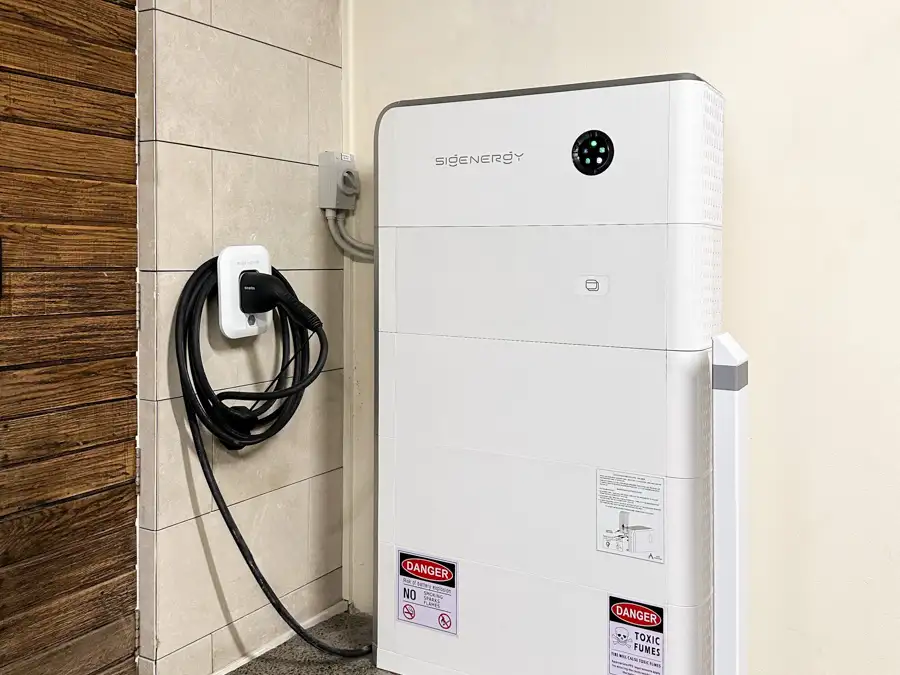
Or the Sigenergy DC charger in the battery
Needs a car with a CCS2 socket. On a single-phase home, its speed also depends on the energy controller and battery size.
Three-phaseWhat can your car take?
On three-phase, the car sets the limit
Single-phase onlye.g. BYD Dolphin
7 kW+40 km each hour
11 kW three-phasee.g. Tesla Model Y, Kia EV5
11 kW+63 km each hour
22 kW three-phaseRare, e.g. Zeekr 7X
22 kW+126 km each hour
Any car with a CCS2 socketDC charger in the battery
12.5 kW+71 km each hour
25 kW with an upgrade
Match the charger to the car. A single-phase-only car on an 11 kW three-phase charger gets only about 3.7 kW, +21 km each hour.
Pick one that can follow your solar
To charge from spare solar, a charger has to see what your panels are making, moment to moment. One from the same brand as your inverter and battery already can.
Solar-following chargeruses only spare solar
Sunny day
18 kWh from solar, 0 from the grid
Cloudy day
4 kWh from solar, 0 from the grid, 14 to top up overnight at the cheap rate
Fixed 7 kW on a timerstarts at 10am
Sunny day
16 kWh from solar, 2 from the grid
Cloudy day
4 kWh from solar, 14 from the grid at the daytime rate
A charger from another brand still charges the car, but usually needs its own meter to follow your solar, runs in a second app and usually can’t see your battery.
Putting it together: three routines, three setups
Here’s how your answers add up for the three common routines, using a typical EV and 30 km a day.
How the numbers were worked out
- Energy for a day's driving = km x the car's kWh per km. For example, 30 km x 0.175 kWh per km = 5.25 kWh.
- Extra solar = that energy ÷ 4, because each kW of panels makes about 4 kWh a day on Sydney's yearly average (about 2.5 kWh in winter). For example, 5.25 ÷ 4 = about 1.3 kW.
- Charging time = energy ÷ charging power. For example, 5.25 kWh ÷ 7 kW = 45 minutes.
- Driving added per hour = charging power ÷ the car's kWh per km. For example, 7 kW ÷ 0.175 = 40 km.
- Car groups are real-world use with charging losses included. Typical 17.5 kWh per 100 km is from RACV's testing of the BYD Atto 3 and Dolphin. Efficient 13.5 and Thirsty 24 use EVDB Australia's real range plus about 17% charging losses: for example, the Tesla Model 3 RWD's 60.9 kWh battery ÷ 528 km = 11.5 kWh per 100 km, or about 13.5 at the wall.
- Battery driving range = battery kWh x 89% (solar-to-battery-to-home efficiency, Tesla Powerwall 3 datasheet) ÷ the car's kWh per km. For example, 25 kWh x 0.89 ÷ 0.175 = about 127 km. Panel counts assume today's panels of about 440 to 485 W. Routines are illustrative.
- Prices are indicative Ausgrid-area retail ranges including GST, late 2026. The solar-following chart is an illustrative day: 10 kW of solar, a car needing 18 kWh, a timer running at 7 kW from 10am, and a solar-following charger using spare solar of at least 1.4 kW between 9am and 4pm.
Sources
- RACV, real-world EV energy use and range testing (18 Jun 2026)
- AAA Real-World Testing Program, how EVs are tested
- EVDB Australia, real-range estimates for the Tesla Model 3, Volvo EX90 and VW ID. Buzz
- Clean Energy Regulator, June quarter 2026, consumer energy resources (updated 9 Sep 2026)
- Ausgrid, time of use pricing
- AER, Solar Sharer Offer fact sheet (May 2026)
- IPART, solar feed-in tariff benchmark for 2026-27
- SolarQuotes, average daily solar output by city